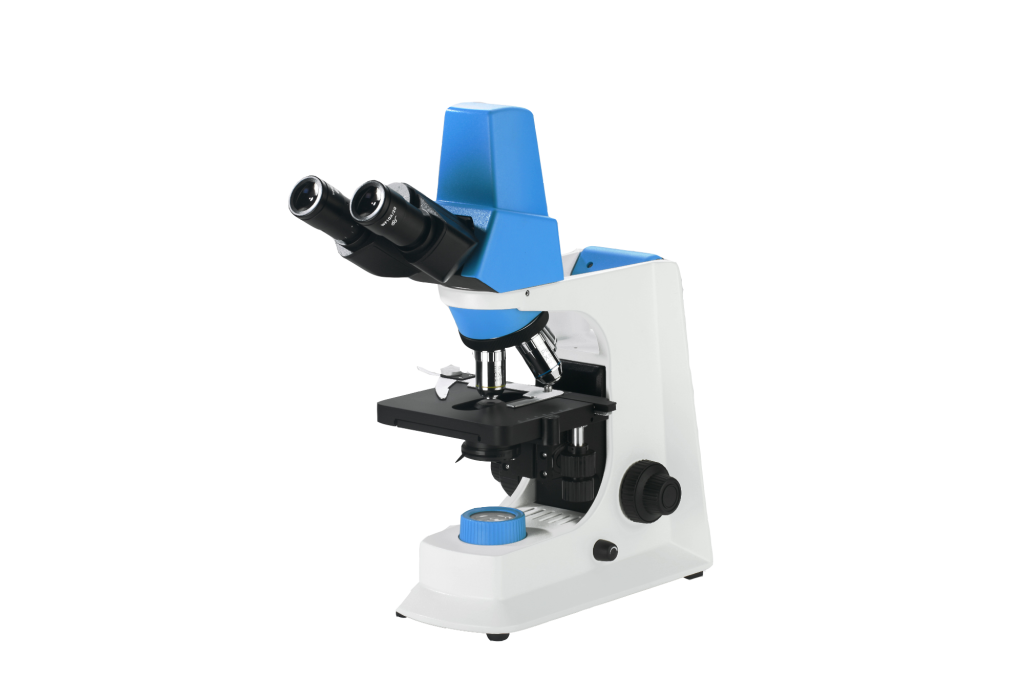
SMART Series Biological Microscope
1. The Illusion of One-Click Accuracy
Auto-measurement tools are marketed as turnkey solutions: capture an image, click a button, and receive precise measurements. But microscopy is inherently complex. Measurements depend on multiple variables—lighting, focus, calibration, contrast, and sample preparation. Automation often oversimplifies these variables, leading to results that look precise but are fundamentally flawed.
2. Sensitivity to Image Quality
Auto-measurement algorithms rely heavily on edge detection and contrast differentiation. This creates several issues:
- Uneven illumination can distort boundaries.
- Noise and artifacts may be mistaken for real features.
- Low contrast samples make it difficult for software to identify edges correctly.
Even minor variations in lighting angle or intensity can significantly alter measurement outcomes. Human operators can compensate visually; algorithms often cannot.
3. Calibration Drift and Misalignment
Accurate measurement requires proper calibration. Many systems:
- Assume calibration remains constant across magnifications
- Fail to account for lens distortion
- Do not prompt users to recalibrate frequently enough
As a result, measurements can drift over time. Auto-measurement tools typically operate on the assumption that calibration is perfect—an assumption that rarely holds in real-world use.
4. Algorithm Limitations
Most integrated software uses generalized image-processing techniques such as:
- Thresholding
- Edge detection
- Blob analysis
These methods struggle with:
- Irregular shapes
- Overlapping features
- Transparent or reflective materials
Because the algorithms are designed to work “well enough” across many scenarios, they often perform poorly in specialized or demanding applications.
5. Lack of Contextual Understanding
Humans interpret images with context—understanding what is relevant and what is not. Auto-measurement tools lack this capability. For example:
- Dust particles may be measured as features of interest
- Shadows may be interpreted as edges
- Background textures can interfere with segmentation
Without contextual awareness, the software cannot distinguish between meaningful structures and irrelevant noise.
6. Over-Reliance on Default Settings
Many users trust default settings, assuming they are optimized. In reality:
- Default thresholds may not suit specific materials
- Detection parameters are rarely universal
- Software rarely adapts dynamically to different samples
This leads to systematic measurement errors that go unnoticed.
7. User Detachment and False Confidence
Automation can reduce user engagement. When measurements are generated instantly:
- Users may skip validation steps
- Errors go unchecked
- Results are accepted without scrutiny
This creates a dangerous combination: high confidence in low-quality data.
8. Integration vs. Specialization
Integrated microscope software prioritizes convenience over precision. Dedicated measurement or image analysis tools often outperform built-in solutions because they offer:
- Advanced parameter tuning
- Better algorithms
- More robust validation workflows
However, these tools require more expertise, which integrated systems try to avoid—at the cost of accuracy.
9. When Auto-Measurement Works (and When It Doesn’t)
Works best:
- High-contrast, simple geometries
- Controlled lighting conditions
- Repetitive, standardized samples
Fails often:
- Complex or irregular shapes
- Variable lighting or reflective surfaces
- High-precision metrology tasks
10. Best Practices to Mitigate Failure
To improve reliability:
- Always verify auto-measurements manually
- Regularly recalibrate your system
- Optimize lighting for consistency
- Adjust detection parameters instead of relying on defaults
- Use specialized software for critical measurements
Conclusion
Auto-measurement in digital microscopes is a useful convenience—but not a substitute for careful analysis. Its limitations stem from simplified algorithms, sensitivity to imaging conditions, and lack of contextual understanding. Treat these tools as assistants, not authorities. Precision in microscopy still depends on informed human oversight.
In the end, the promise of “one-click measurement” is appealing—but accuracy requires more than automation.